ProPR (free)
The self-hosted product layer: plans, tasks, GitHub integration, PR follow-up, logs, settings, CLI, and task history. No license fee, no seat charge.
ProPR is free, and it never marks up a token. You run planning, task history, logs, pull requests, and follow-ups in your own deployment, then pay providers directly through subscriptions or metered API billing. Provider charges go directly to your account.
ProPR itself is free. The underlying provider usage — whether through subscriptions you already pay for or metered API billing — is the only cost beyond your own infrastructure.
The headline subscription covers only part of AI development cost. Other costs include long contexts, repeated retries, premium models, background agents, manual PR preparation, branch cleanup, review follow-ups, and re-establishing context after a private agent session is gone.
ProPR makes those choices explicit. A task has a plan, selected agent, isolated execution record, pull request, logs, usage, and follow-up history. When Agent Tank is enabled, ProPR ties subscription and rate-limit information back to the change that consumed it.
The self-hosted product layer: plans, tasks, GitHub integration, PR follow-up, logs, settings, CLI, and task history. No license fee, no seat charge.
The Docker-capable host, storage, database state, repositories, worker capacity, and operational monitoring you choose to run.
The model or agent spend behind each task. Use your existing AI provider subscriptions (no additional cost) or direct API billing for metered accounting.
A planning pass, careful implementation, inexpensive review, and PR follow-up can use different providers. ProPR keeps the branch and history connected while the agent changes.
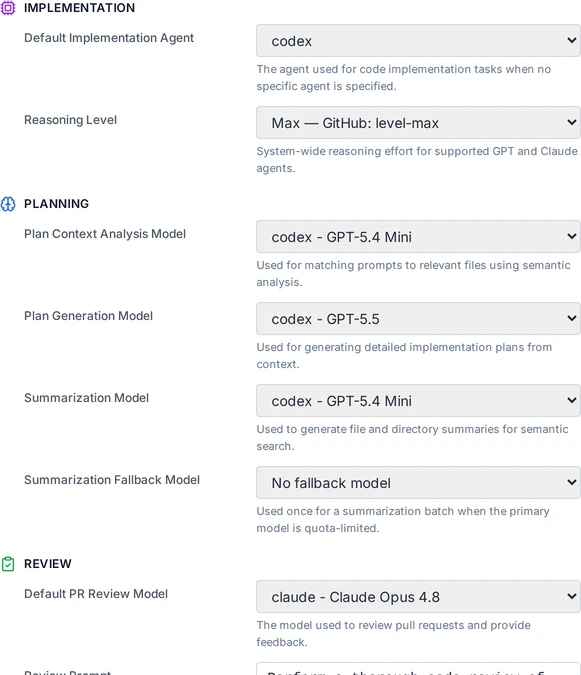
Claude Code, Codex, Antigravity CLI, and other supported agents can use provider subscriptions directly. ProPR adds no token markup; provider plan limits still apply.
For usage that needs provider-level billing, model-specific control, or clearer per-task accounting, bring your own API keys instead.
Use the model that fits the phase, then keep follow-up commits, retries, and review history on the same PR.
ProPR records every model call — model, token usage, cost, and duration — and ties it back to the task and repository that spent it, so agent spend is never invisible.

A low monthly seat price can still be expensive if the team spends time turning private agent output into branches, PR summaries, follow-up prompts, and recovery steps.
The cost comparison places ProPR beside hosted agents, AI IDEs, app builders, open-source orchestration, direct agents, and PR review tools.